


How to squat with a barbell
The barbell squat is a cornerstone of many strength programs. This movement works the whole body, from keeping the core engaged to keeping the upper body stable, and obviously generating a lot of power through the legs.
Whether you're new to squatting or looking to refine your technique, here is how to squat step by step.
Table of contents
Setting up the bar
Finding your stance
Bracing
Descend under control
Finding your depth
Drive back up
Common mistakes
Setting up the bar for back squats
Set the J-hooks around shoulder height, low enough to unrack the bar without standing on your toes.
Place the bar across your upper traps, not directly on your neck.
Grip the bar at a comfortable width that allows you to keep it secure.
Stand up to unrack the bar, then take a couple of controlled steps back.
Remember to set up the safety pins just below your squat depth

Find your stance
A good squat stance is one that works for you
A good place to start is with your feet slightly wider than hip width apart
Turn the toes out slightly
Experiment with the above until you find the stance you prefer
Note: it's ok to elevate your heels a few centimetres on a stable surface. This will allow the chest to stay a little more upright and the hips to go lower


Bracing for the barbell squat
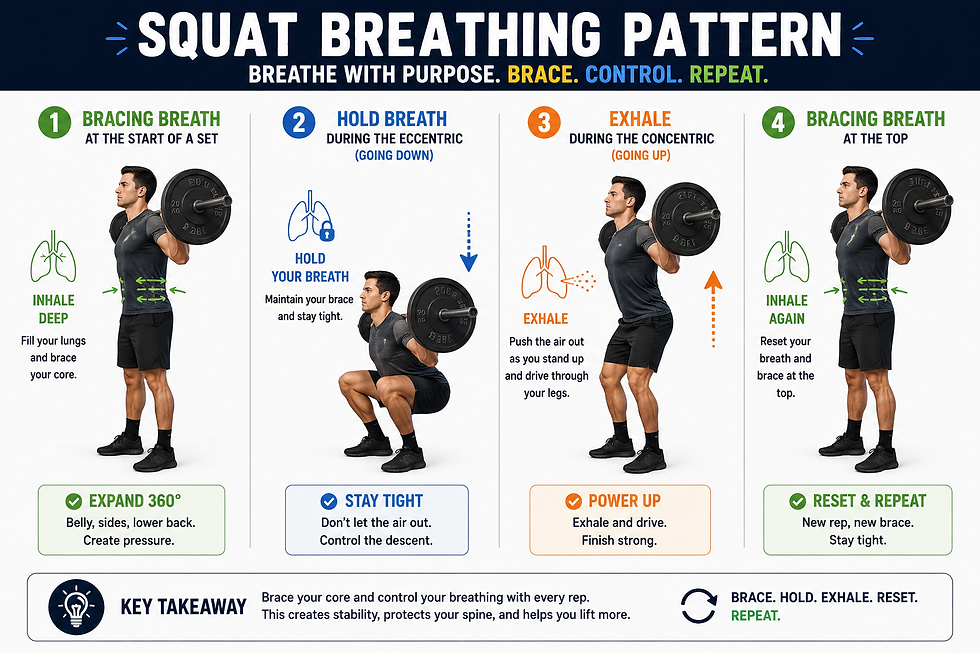
Once you've got your stance, you need to brace your core. This will stabilize the torso and support the spine during the lift.
Tighten up your core muscles (pretend like someone is about to punch you in the stomach)
Inhale through the nose and expand your ribcage 360°
Think about expanding your sides, stomach and back
Keep the lower ribs parallel to your pelvis as you do this
The image below illustrates what NOT to do. You can see my back is overly arched, meaning I do not have 360° expansion throughout my torso

Descend under control
Once you are braced, it's time to go down.
Bend the knees and hips at the same time
Keep the knees in line with your toes
Keep the feet planted on the ground
Control the descent, take 2-3 seconds to go down and prevent gravity from taking over.
How low should you go? Finding your depth
Squat depth greatly depends on mobility, experience and training goals. There is no one depth that everyone needs to do.
There are two squat depth I primarly use for myself and my clients:
Hips below knees aka below parallel when thinking about the relation between the leg and the ground If all else is equal (good mobility, no injuries), this is my standard for myself and my clients.

Hips just below parallel Above parallel. This is a great depth to learn technique or to focus on strength and power.

Different types of squats will allow for different depths:


Drive back up
Time to get strong and make those leg work.
Push through the feet
Keep ribs parallel to pelvis
Extend the knees and hips
Finish standing tall
Reset your breath if needed before the next reps
Common squatting mistakes
Knees caving in
Always make sure to keep the knees aligned with the toes.


Rounding the back
To avoid rounding your back, focus on creating a proper brace. To maintain a proper brace throughout movement you can experiment with different bar position (back, front or zercher) and elevating the heels.

Heels lifting off the floor
If the heels come off the ground as you descent, you can try elevating your heels on a stable wedge or wearing weightlifting shoes. You can also experiment with your stance and reduce the load while you work on your technique.
Losing control on the descent
You must always be in control as you lower yourself into the squat. If you feel like you are bouncing from the bottom, or dropping into the hole, lower the weights.
Hips going up before the torso
Shooting the hips before the torso is called doing a striper squat. Great on Friday nights, less than ideal in the gym. This is often the result of the quads not being able to do the work properly.
Lower the weights and focus on pushing the ground away.
Master the Barbell Squat
The barbell squat is a fantastic exercise for building strength and muscle, but good technique comes before heavy weights.
Find a stance that works for you, brace your core, control the descent and squat to a depth you can manage comfortably. Start light, practise consistently and gradually increase the weight as your technique improves.
And remember: the goal isn't to squat like the person next to you. It's to find a strong, controlled position that works for your body.
Now load up the bar and get squatting!
Clem


Comments