


how to bench press 100kg (225 lbs)
Bench pressing 100kg, aka 225 lbs, aka two plates, is classic bench mark (no pun intended) for guys who enjoy lifting weights.
Getting there is relatively straightforward: simply consistently benching and applying progressive overload will get you there in most cases.
In this article, I'll go over basic technique and progressive overload schemes that will help you speed up that process.
Table of contents
Best assistance exercises
Bench Press Technique
Everyone's technique might be slightly different depending personal preferences and experience. Below will cover you bases if you are new to the bench press.
Bench press Set up
Lie down on the bench with your eyes underneath the bar. This is allow you stay clear of the pins when lifting the bar up and down.
Feet should be flat on the ground, shoulder width distance, directly under the knees.
Hands position should be wide. I like to put my index finger on the outer ring of a standard olympic bar. The wider your hands, the more pecs will be work, the closer your hands, the more tricep will work. Where to put on your hands is one of the most individualized aspects of benching, so take the time to find the position that makes your feel the strongest.
Take an inhale, brace your core, and unrack the bar.
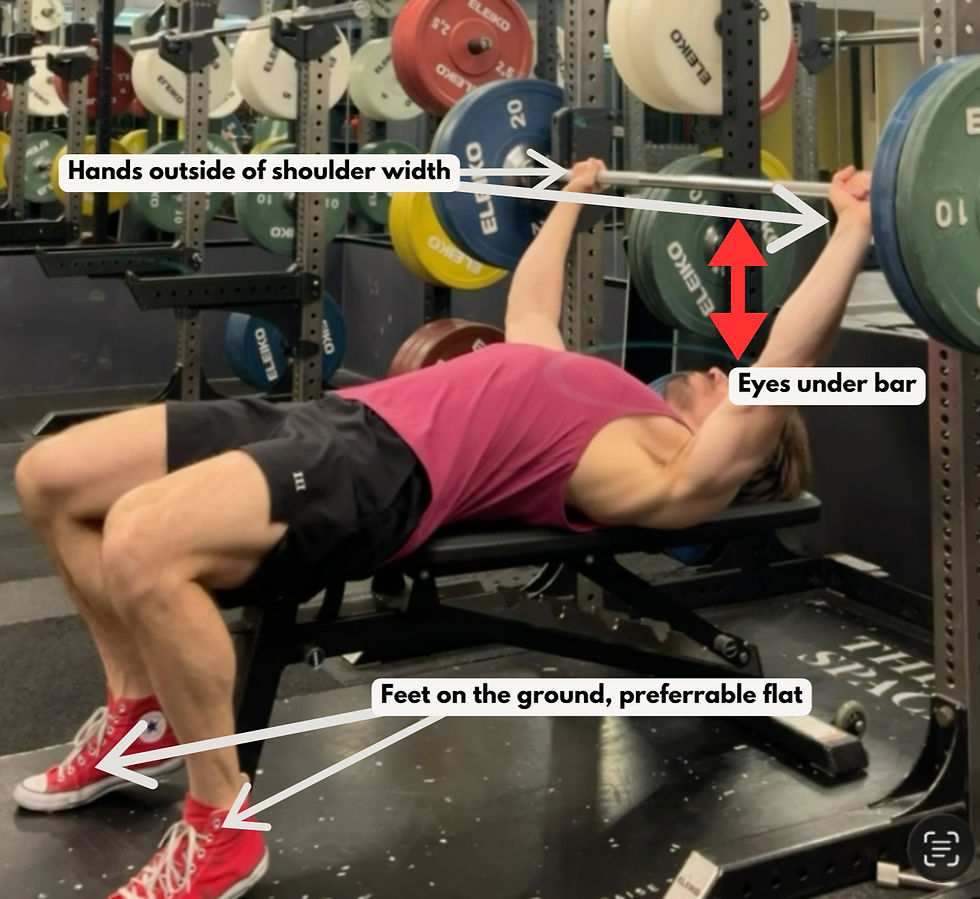
At the top of the rep
The bar should be directly above your chest, your arms perpendicular from the ground.
Before lowering the bar:
Engage your lats by slightly pulling the shoulder blades towards your bum
Rebracing the core if necessary by taking another bracing inhalation
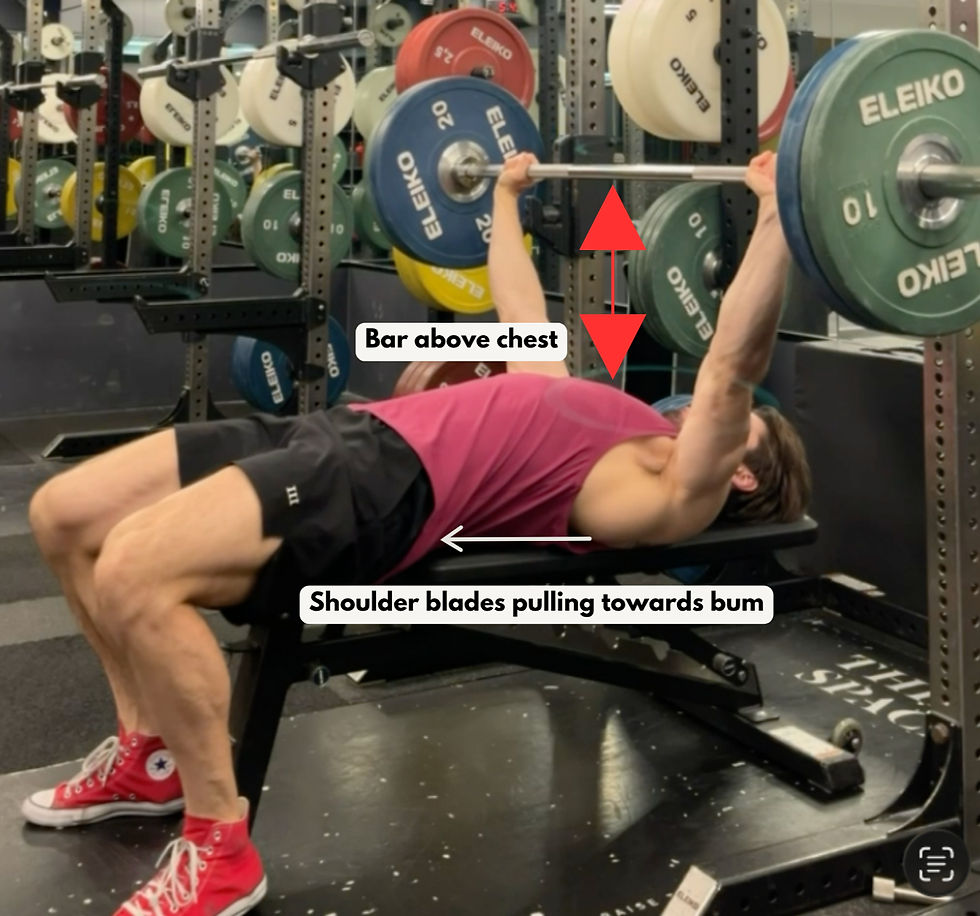
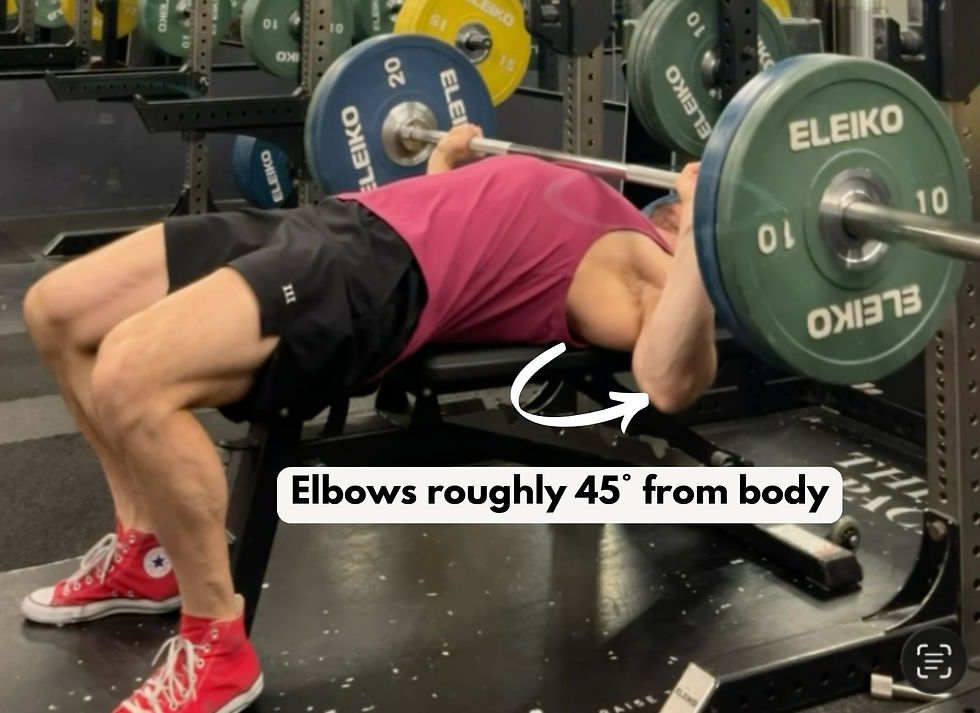
Lowering the bar
The standard for a completed rep is to touch your chest. It is an sacred, international, unspoken agreement that not touching your chest with the bar is a no rep.
The bar should touch near your lower chest.
Head stays on the bench.
Hold your breath as you lower the bar.
You know your lats are properly engaged when your elbows make an arrow shape with your body at the body.
Pause for a second at the bottom before pushing back up.
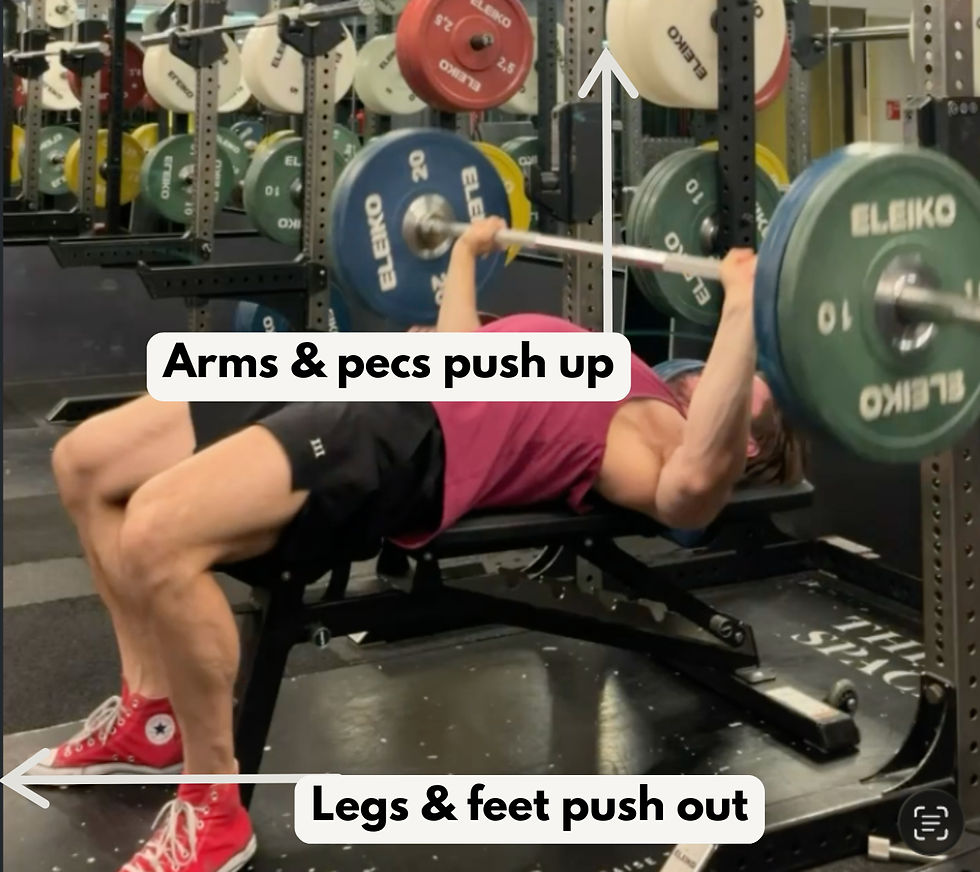
Pressing the bar up
Exhale and push the bar back up.
Leg drive: a key factor. Using your legs to stabilize your chest and generate power will help you push more weight. To do so, pretend like you want to slide up the bench by using your legs to push the ground away. This will create tension in your full body, creating more stability in your upper body and generating some power you can transfer into the bar on the way up. Leg drive is the most technical aspect for beginners. Start by focusing on it even with your warm up sets to get used to it.
Hips stay on the bench!
Arms lock out at the end before the beginning of the next rep.
Now that you have the basic technique down, let's talk about what reps are best to reach a 100kg PR.
What Reps To Use?
Let's remember what different rep ranges achieve:
Few reps (<5) with heavy weights increase strength the most, increase muscle size but are costly on the nervous system and require solid technique to be effective.
More reps (>6) with moderate weights increase muscle size, which in turn increases strength (albeit at a lower speed than heavy weights) but are easier to recover from and are more forgiving on technique.
Bearing that in mind, which reps to use is a balancing act. Finding the right weekly mix of heavy reps and moderate weights will depend greatly on your experience and technique.
From what I've seen as a trainer, it's not worth going heavy in your first 6 months of lifting. If you are starting from scratch, use moderate weights for reps of 6-12 to build a foundation of muscle and practice proper technique.
If you are eager to lift heavy weights and feel impatient, remember that
Strength is a skill
As with any skills, it has many components, and technique is the most important one. Luckily for us, this is achieved with lighter weights and can be practiced from day one.
When do you know you have good technique?
There is a simple test to evaluate your technique on any exercise: there should be little difference between your first and last rep. Visually, they should look pretty identical and their should not be a massive and sudden increase in difficulty in the last few reps.
An easy way to test yourself is with a 5 rep sub max effort.
Find a spotter, this is essential because you are working with heavy weights
Pick a weight that should allow you to do 5 reps
Do the 5 reps
With proper technique, your last rep shouldn't look very different from your first. Your first rep should feel quite hard, but you should be able to do 5 of them
With poor technique, the first 3 reps will feel easy and the last 2 impossible. Proper technique allows you to work under greater pressure for longer.
Once again, I cannot stress enough the importance of using a spotter. With improper technique, the odds of you ending stuck under the bar are pretty high.
Another good option is to ask someone who is better than you at bench pressing how your form looks. The big advantage of this is that the odds of being stuck under a bar are zero.
Ok now let's talk about the more important part: how to progressively add more reps in a civilised manner.
Progressive overload and workout plan
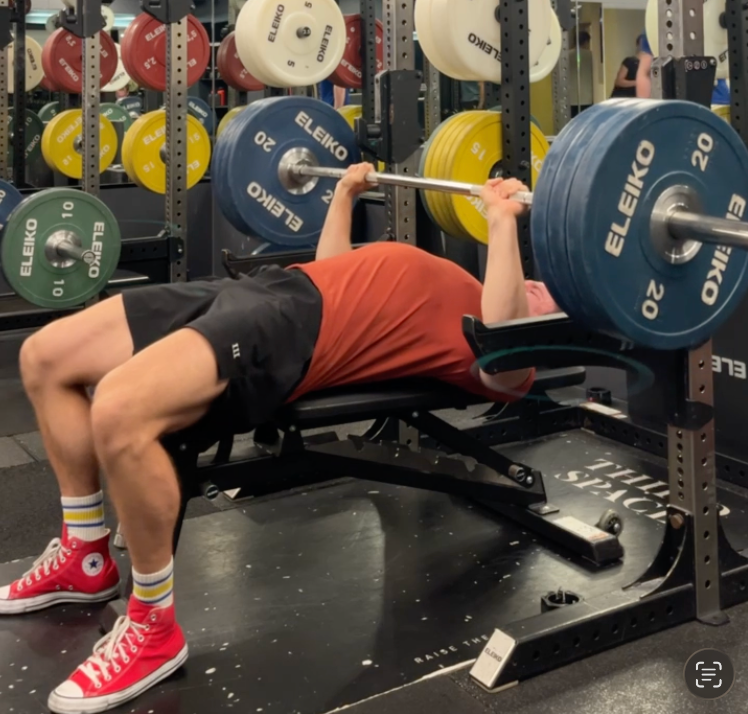
I have used the following plan and progressive overload scheme may times to help clients bench press 100kg for the first time.
Bench Press Workout Plan
Day 1 Strength: 5 x 5 on the bench press
The goal of this workout is to get comfortable pushing heavy weights. 5 x 5 is a great balance between volume and strength work.
Day 2 Technique: 3 x 5-8 of paused bench. Hold for 3 seconds at the bottom.
The goal here is to work on the weak spot, which is usually the bottom part of the rep for most people.
If your weakness lies other places, use different exercises to improve it. Close grip bench helps strengthen the tricep. Pin presses help overcome sticking points at various moments in the movement.
Technique work is always done with lighter weights. This allows the body to recover from day 1 before hitting volume on day 3.
Day 3 Volume: 3 x 8 on either bench press or incline bench press
The goal of volume work is to build muscle mass, which helps getting stronger in the long run.
I've always prefered doing the strength day early in the week when the body is more fresh from the weekend. If, on the other hand, the weekend was very demanding physically, (maybe you did a crazy run or a long hike), then save the strength day for later in the week.
Progressing the workouts
How to progress the strength days
Every two weeks, we take away one set and one rep:
Week 1 and 2: 5 x 5
Week 3 and 4: 4 x 4
Week 5 and 6: 3 x 3
This allows the body to get used to lifting heavier and heavier weights over the weeks. When week 6 is over, start from week 1 again and repeat the cycle. If done properly, you will be able to use a heavier weight that the initial week.
So if you did 5 sets of 5 with 60kgs on week 1, you will most likely be able to use 65kg or 70kg on week 7 when you start 5 x 5 again.
Progressing technique work
This is more up to you, I usually always leave it to my clients to decide which weight they use. Since the goal of this workout is to get better at the movement, we don't chase heavier weights.
Progressing the volume workouts
Every other weeks, we add 1 set:
Week 1 and 2: 3 x 8
Week 3 and 4: 4 x 8
Week 5 and 6: 5 x 8
Important note: when we increase volume, it is completely fine to lower the weights slightly. I know a lot of us don't like doing this because it seems like we are moving in the opposite direction of our goal.
But trust me, lowering the weights when volume goes up is often a clear sign of maturing in the gym.
Best assistance exercises for the bench press
The following exercises can be done as secondary exercises to complement your main bench press workout.
Adding one or two of these each week will boost training volume. Keep in mind that you need to be able to recover from them for your main bench workouts.
Incline bench press, dumbbells and barbell
Dips or weighted dips
Chest flys, dumbbells, cables or machine
Chest press machine
For shoulder development:
Shoulder press
Military press
For more tricep focused work:
Skull crushers
Close grip bench press
Over head cable tricep extensions
Conclusion
Bench pressing 100kg is achievable for most men who start out at the gym. Given time and practive, those two plates will end up on the bar at some point in the near future.
Focusing on technique and following a simple plan is the easiest way to get there.
Stay consistent with the workouts, don't ignore nutrition and recovery, and send me a message when you get too 100kg.
Happy training,
Clem



Comments